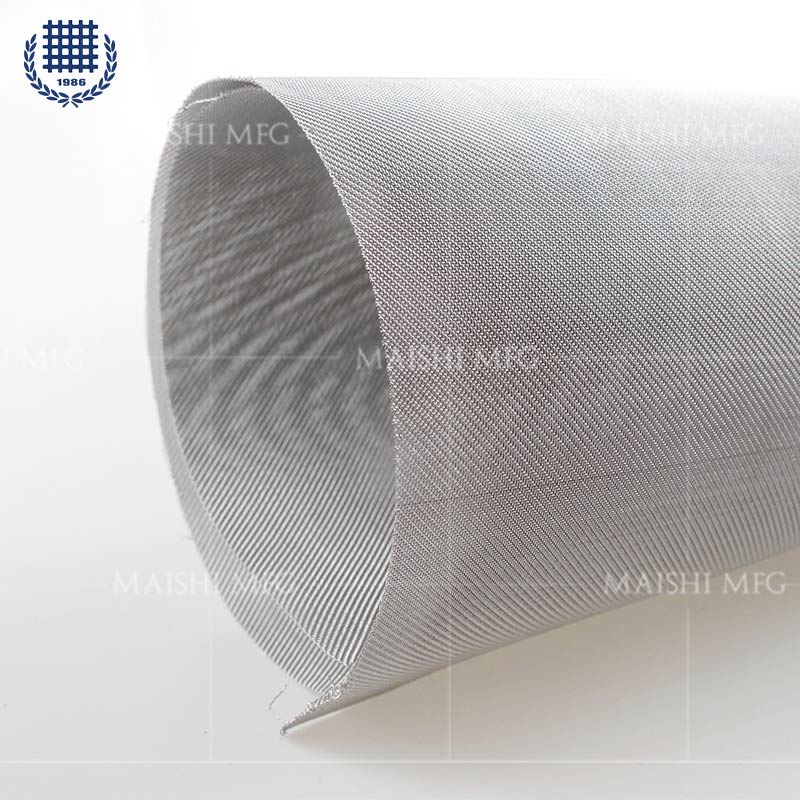
The Effect Of Ni And Gr In Stainless Steel Wire Mesh
Stainless steel wire mesh is heat resistant, acid resistant, corrosion resistant and wear resistant. Because of these characteristics, stainless steel wire mesh is widely used in mining, chemical, food, pharmaceutical and other industries.
Stainless steel is composed of chromium and nickel in iron combined with chromium-nickel stainless steel, which is a better stainless steel. The wire mesh processed by this material is called “stainless steel wire mesh”, and a large amount of nickel is added to the stainless steel in order to obtain a single austenite structure, thereby improving its corrosion resistance and processability. It has strong plasticity and toughness at normal temperature and low temperature, is not magnetic, and has good resistance to intergranular corrosion.
1. Chromium plays a major role in the corrosion resistance of stainless steel: chromium is the main element determining the corrosion resistance of stainless steel. Because chromium in steel can make the stainless steel passivate in the oxidizing medium, that is, a thin layer is formed on the surface. The film is enriched in chromium in this film. The higher the chromium content in the steel, the stronger the corrosion resistance. In addition, chromium can strengthen the mechanical properties and process properties of steel.
2. The effect of nickel on stainless steel wire mesh can only be fully demonstrated when it is combined with chromium. Nickel is an alloying element for forming austenite. When nickel is combined with chromium, the metallographic structure can be changed from single-phase ferrite to austenite and ferrite dual-phase structure. After heat treatment, the strength can be improved. Therefore, it has stronger stainless corrosion resistance and good deformation properties.
3. Effect of impurities on properties When the carbon content is between 0.1% and 0.3%, after annealing, carbon will precipitate in the graphite state on the lattice boundary, destroying the bonding force between the grains, strongly Reducing the strength and plasticity of nickel makes machining deformation difficult. In addition, carbon has a strong affinity with chromium to form a series of carbides. The higher the carbon content in the steel, the more chromium carbide is formed, the chromium content in the solid solution is relatively reduced, and the corrosion resistance of the steel is lowered. Sulfur is a harmful impurity. Sulfur and nickel form a Ni3S2 compound. Ni3S2 and nickel form a low-melting eutectic at 625 °C, which is distributed on the grain boundary. When the heat distortion temperature exceeds the eutectic melting point, it is cracked along the grain boundary. , the phenomenon of so-called “hot brittleness”. Ni3S2 produced by nickel with sulfur at normal temperature can cause cold brittleness and make the stainless steel wire mesh easy to brittleness.